


The Drawer of Four Phones, and the Red One That Stayed on My Nightstand
The top drawer of my nightstand used to hold four telephones. Not one of them worked the way I wanted, and not one of them was broken.
There was the hand-me-down smartphone from my son, still in its rubber case.
There was a tablet from Christmas, a second smartphone with "easy mode" from a television ad, and a silver flip phone from 2009 with a dead battery.
A retired school secretary who ran a six-line office phone for 31 years meets a choir friend's flip phone. The plan, the fees and the fine print, read line by line.
 On the Nightstand · Red Flip3
Under all four sat a stack of letters from my granddaughter, tied with a lavender ribbon. Those letters were the only part of the drawer I understood.
I'm seventy-four. For thirty-one years I sat at the front desk of an elementary school in Kettering, Ohio, and I answered a telephone with six lines and a hold button.
I could put a worried mother on line two, a bus driver on line four and the superintendent on hold.
I did it without looking down, while signing a tardy slip with my other hand.
And for the last six years, I could not reliably answer my own phone. That's the sentence this column is built around, and I've made my peace with writing it.
So this is a column about a drawer, and about what finally came out of it.
It's about a red flip phone with buttons the size of my thumbnail, and about a plan with five prices on it.
It's also about the letters.
My granddaughter Lainey and I have written each other by hand since she left for college, because I couldn't find the text messages on any of those four phones.
If you have a drawer like mine, you'll know most of this already. You just haven't seen anybody write it down with the prices next to it.
Thirty-One Years on Six Lines
Oakview Elementary had a beige office phone the size of a bread box. It had six clear buttons along the bottom that lit up amber when a call came in.
I loved that phone. I loved that a button did one thing, that it did the same thing every day, and that I could feel it click under my finger.
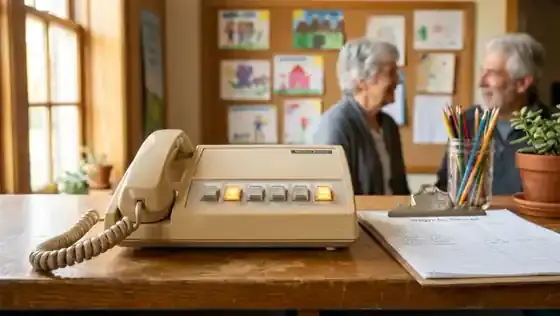
A school secretary's whole job is knowing where things are.
Where the spare key to the health room is, which child gets picked up by the grandmother on Thursdays, which bus runs late in snow.
I knew roughly four hundred phone numbers by heart. Parents, bus drivers, the district office, the plumber who came out for the boiler in 1997.
I don't say that to brag. I say it so you'll understand how strange it felt, last spring, to stand at the pharmacy counter and not know my own cell number.
The young man asked for it to look up my account.
I opened my mouth and the number simply wasn't there, the way a word sometimes sits on the tip of your tongue and won't come forward.
I had to dig out the hand-me-down phone and hunt through three menus for it. A line formed behind me while I squinted at a screen the size of a playing card.
I'd like to tell you that was the first time. It was only the first time with an audience.
Four Phones, and Nobody Explained a Single One
My husband, Frank, handled all the telephones in our house for forty-four years. He wasn't technical; he simply liked buttons, and he liked being the one who knew.
When Frank passed in 2019, the telephones passed to me along with the furnace filters and the gutter man's number. The furnace filters I figured out.
Phone number one was the hand-me-down. My son Doug gave me his old smartphone when he upgraded, already set up and charged, with his photo still as the background.
He showed me how to swipe it open twice at Thanksgiving. By Christmas I had forgotten whether you swipe up or sideways, and I was too proud to call him and ask.
The trouble with a touchscreen, for me, is that nothing is where you left it. You touch the glass, the picture slides somewhere else, and the button you wanted is gone.
Twice I called a woman in Toledo by accident while the phone sat in my cardigan pocket.
The second time she said, quite kindly, "Ma'am, I think you're calling me from your sweater."
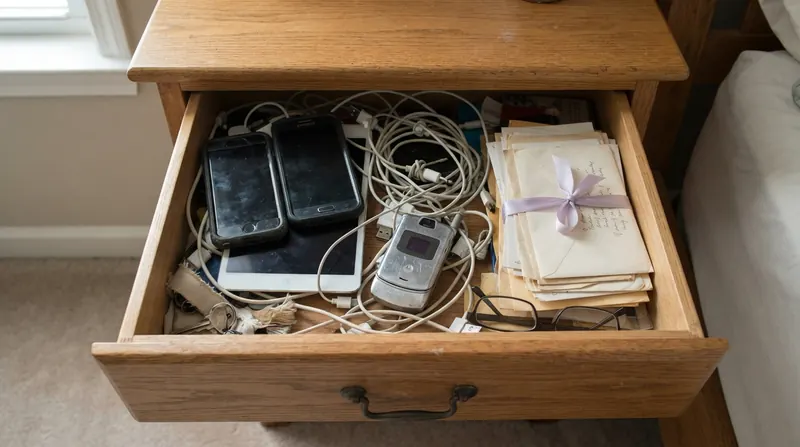
Phone number two was the tablet. My daughter-in-law meant well; she said I could see the grandchildren's faces on video calls.
I did see them, twice. Both times someone else set up the call, and both times I spent the first minute looking at my own chin.
Then the tablet wanted an update, and then a password I'd never chosen. It has lived in the drawer since the Fourth of July.
Phone number three came from a television ad. It was a smartphone with an "easy mode," and the man in the ad was my age and laughing.
The easy mode had large tiles instead of small ones. It was still glass, still sliding, and the tiles still rearranged themselves when I pressed too long.
I returned it, which took two phone calls and a trip to the post office. I'm still not sure I got the whole refund back.
Phone number four was the old silver flip phone. I bought it in 2009, and I adored it for a year until the company stopped supporting it.
It had a lid that closed with a snap, and when you closed it the call was over. I can't tell you how much I missed that snap.
So that was the drawer. Four phones, one charger that fit two of them, and a woman who used to run six lines with one hand.
What Slips, and What Doesn't
I want to be careful in this section, because I'm writing about my own head and nobody else's. I'm not a clinician and this isn't a column about anybody's medical chart.
But I'll be honest about the small things, because I suspect you have them too.
The name of the neighbor I've waved to for thirty years, the keys that moved, the list I forgot at the grocery store.
My neighbor across the street is Arturo Peña. He's mowed his lawn on Saturday mornings since 1993 and brought me tamales every Christmas since Frank died.
Last March I stood on my porch and his first name simply would not come. I waved, he waved, and I said "Morning, neighbor!" like a woman running for county commissioner.
The keys are a daily story. They're always in the house, usually in a coat pocket, occasionally in the refrigerator next to the butter.
And the grocery list I write every Sunday sits on the kitchen counter while I walk the aisles of Kroger trying to rebuild it from scratch.
None of that is a phone problem. I want that on the record before I go any further, because no telephone on earth will put a list back in your pocket.
But here's what I noticed. Every one of those small slips felt worse when a touchscreen was involved, because the screen added a second thing to forget.
I'd forget a number, then forget which phone had it, then forget whether you swipe up or sideways. Three layers of fumbling, all for one call.
With the old school phone, a button was a button. My fingers remembered the six lines long after my head stopped thinking about them.
I wrote that note in pencil and taped it to the drawer in April. Reading it back now, it's the funniest and saddest thing in my house.
Why a Grandmother and a College Girl Write by Hand
My granddaughter Lainey is twenty. She's in her second year at a state university in Colorado, studying soil science, of all things.
When she left for school, she set up a group text so I could see her photos. I never found the group text again after that first afternoon.
So in her first October away, a letter arrived in my mailbox. It was on lined paper torn from a spiral notebook, with a pressed aspen leaf inside.

"Gran," it began, "I'm not giving up on you. If you won't text, I'll write."
I cried at the mailbox, which Arturo pretended not to see from his lawn mower.
I wrote back that night on the good cream stationery Frank bought me in 1998. We've traded a letter about every ten days ever since.
I treasure those letters, and I mean that. But a letter takes four days to get to Colorado, and a twenty-year-old's week can change a lot in four days.
She told me about a hard exam in a letter that arrived after the exam was over.
She told me she'd caught a bad cold in a letter that arrived after she was well.
And on her twentieth birthday, I called the wrong phone. I dialed her old number from the drawer phone, got a stranger, and couldn't find the new one on the tablet.
I finally reached her at 9:40 that night, from my kitchen landline, using the number she'd written on the back of an envelope. She'd been waiting by her phone since noon.
She was gracious about it, because she is gracious about everything. I hung up and sat at the kitchen table for a long time with the envelope in my hand.
"The one you will actually open." I read that line a dozen times.
I'd been trying to learn phones built for other people, and I'd never once asked what kind of phone I would open.
The answer, if I'm honest, was obvious. I wanted a phone with a lid, with buttons I could feel, and with a screen that stayed still.
I wanted the snap back.
I just didn't believe such a phone still existed in 2026, let alone one that could reach a college girl in Colorado.
Verna Opens a Red Phone After Choir
I sing alto in the Wednesday choir at our church. Next to me, for nineteen years, has stood Verna Hensley, seventy-nine, the loudest alto in Montgomery County.
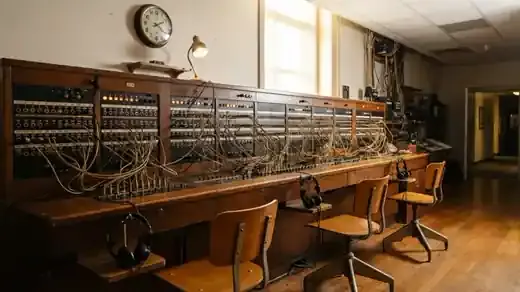
Verna was a switchboard operator for Ohio Bell from 1965 until they automated her out of a job. She still says "Number, please?" when she answers the door.
The Wednesday after Lainey's letter, we were walking to our cars in the church parking lot. Verna's coat pocket started ringing, a loud old-fashioned ring like a hallway phone.
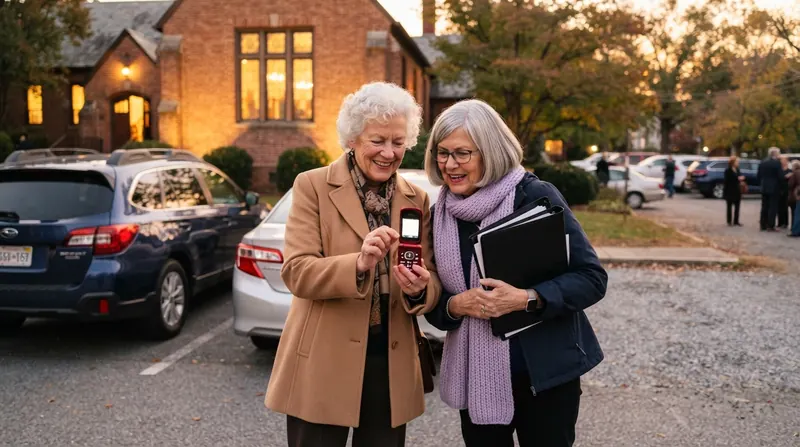
She pulled out a red phone, flipped it open with her thumb and said, "Hensley." It was her son calling from Dayton about Sunday dinner.
Ninety seconds later she said, "Love you, bye," and snapped the lid shut.
That snap went straight through me like the first note of a hymn you haven't heard in years.
"Verna," I said, "where on earth did you get a flip phone in 2026?" She looked at me the way she looks at a soprano who's come in early.
"Nora, they never stopped making them," she said. "They just stopped putting them in the front window."
Then she handed it to me, right there between her Buick and my Corolla.
It was heavier than I expected, with a soft grip on the back that didn't slide in my hand.
When I opened the lid, the buttons on the keypad lit up. They were big, separate keys with real edges, and they clicked when I pressed them.
The screen inside was small but it was bright, and the words on it were large. There was a list, top to bottom, the way a list ought to be.
"Now watch," Verna said, and took it back. She held down a button, said "Dial Raymond" into the phone, and it called her son again.
Her son answered, puzzled. "Just showing Nora," Verna told him, and snapped the lid shut on the poor man.
Why an Old Operator Trusts a Phone With a Lid
I asked Verna the question I'd been asking myself for six years. Why could she run a phone and I couldn't, when we'd both run telephones for a living?
Her answer is the best thing anyone said to me all year. "Because I quit trying to learn phones that were built for my grandson."
"A switchboard," she said, "is a promise that the same plug goes in the same hole every time. That's what I need from a telephone."
"The glass phones break that promise every week. Something updates, something moves, and you're the one who feels stupid."
She'd been through two smartphones herself before her son found the flip phone. She called them "the slippery ones."
I asked her what it was. She said it was a Jitterbug Flip3, sold by a company called Lively, which is part of Best Buy.
She'd had it about a year. Her son set it up on the phone with the company, and she kept her old number.
"The phone was cheap," she said. "The plan is the part you read.
Read every line, Nora. Then read it again."
That, coming from Verna, was the most persuasive sentence in the world. She's the woman who caught the church's insurance company double-billing the boiler in 2011.
Did you get home? Write down the name: Jitterbug Flip3, by Lively.
8:12Home, and it took me 19 min to find this. Written on the back of the hymn sheet.
8:31Good. Read the plan before you buy, and call them; they answer.
8:32Yes ma'am. Number please?
8:40Nineteen minutes to find a text message. That number made the decision for me more than anything Verna said.
I didn't order it that night. I did what thirty-one years in a school office taught me to do with any purchase order: I pulled the paperwork first.
Reading the Phone Like a Purchase Order
Arturo's grandson set up the tablet so I could read the seller's page in big print.
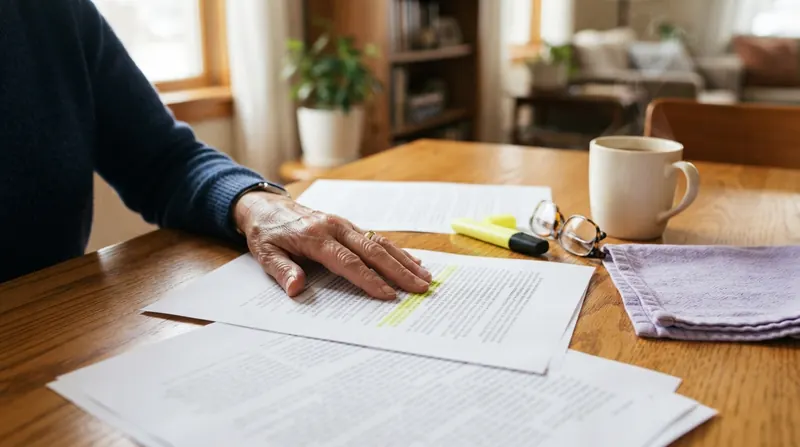
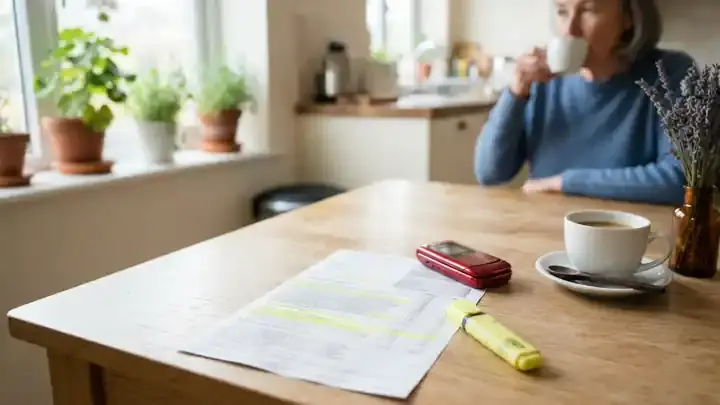
I printed the whole thing at the library, eleven pages, and spread it across my dining table.
I read it with a yellow highlighter and a cup of coffee, the way I used to read the district's supply contracts.
Here is what the page says, in my own words, with nothing added.
The phone itself. The listing calls it the Jitterbug Flip3, 64GB, and sells it in red or black.
It's a flip phone: a lid that opens and closes, with the keypad on the bottom half and the screen on the top.
The screen. The listing says 3.2 inches, "large, higher-contrast," with "big, clear text."
That's smaller than a smartphone and much larger than my old silver flip.
The buttons. "Big, tactile buttons with backlighting make it easy to dial."
Tactile means you can feel them, and backlighting means they light up in a dim room.
The grip. "Comfortable no-slip grip."
Verna's phone didn't slide in my hand in a cold parking lot, so I'll vouch for that one personally.
Calling by voice. "Just say 'Dial' and the contact name to place a call."
That's exactly what I watched Verna do with her son, and it's printed right on the page.
Speed dial and a loud speaker. Both are listed by name.
There's also a feature called "Read Out," which reads things on the screen aloud.
Hearing aids. The listing says it's hearing-aid compatible and prints a measurement I'll come back to, because I had to look up what it meant.
The battery. "Up to 12 hours" of talk time, with an asterisk saying actual battery life will vary and will "naturally decrease with time."
I appreciated the asterisk.
The camera. It has one, 5 megapixels with a flash.
I mention it only because I didn't expect it, and because Lainey later made me promise to use it.
Wi-Fi calling and 5G. The listing says it can make calls over home Wi-Fi when the cell signal is weak.
My basement laundry room has been a dead zone since 1987, so I underlined that.
What comes in the box. A wall charger, a USB-C cable a little over three feet long, a tool for the SIM card and a printed user guide.
A printed guide! I underlined that twice.
The Phone Was Cheap; the Plan Is the Part You Read
Verna was right, and she's always right about money. The phone price on the page is only the first of five numbers.
I'm going to lay all five out in a row, because I've seen too many advertisements that show you the first number and hope you don't ask about the rest.
Number one: the phone. $59.99, marked down from a regular price of $79.99. The page calls it 25 percent off.
Number two: activation. $35, once. The specifications say the phone "requires Lively plan at activation," which you do after it arrives, by phone, online or in a store.
Number three: the monthly plan. Lively's cheapest plan for this phone is called Basic, at $14.99 a month.
That price includes a $5 discount for paperless billing; with paper bills it's $19.99.
Number four: the administrative fee. $3.23 a month, on top of the plan. It's printed right next to the plan price, which I give them credit for.
Number five: taxes and surcharges. The page says "variable USF/surcharges and taxes," which depend on where you live.
USF is the Universal Service Fund charge most phone bills carry.
So, before taxes, the Basic plan works out to $18.22 a month with the admin fee. Add whatever your state and the federal fund add, and that's your monthly phone bill.
Now, what do you get for $14.99? The Basic plan includes 300 minutes and 300 text messages a month.
If you want unlimited talk and text, it's $5 more a month on any of the three plans.
The Basic plan also includes something called Ask Lively, which the page describes as 24/7 operators.
You can ask them to look up a number, get directions or help you with the phone.
I'll be honest: an operator who looks up numbers made Verna laugh out loud. "They hired me back," she said, "and didn't even send a card."
What the Help Button Does, and on Which Plan
Here's the line on the page that I read three times. The phone has a dedicated Help button, and the advertising mentions "24/7 help in emergencies."
But the emergency service behind that button, called Urgent Response, is not part of the Basic plan.
The plan chart marks it "No" for Basic and "Yes" for the two plans above it.
The listing's own words are "Upgrade to Urgent Response service." The Preferred plan is $34.99 a month and the Premium plan is $44.99, both with the paperless discount.
The Preferred plan adds Urgent Response and an app called Lively Link that can alert family members. The Premium plan adds two health-line services on top of that.
I'm not going to tell you which plan you need.
I'll tell you what I did, which was choose Basic, because I live four doors from Arturo and I have a landline in the kitchen.
What I won't do is let anybody believe the Help button answers emergencies on the $14.99 plan.
It doesn't, according to the seller's own chart, and you deserve to know that before you pay.
If you live alone, far from family, and that button is the reason you're interested, read the Preferred plan carefully.
Then call the company and ask them to say it back to you.
Thirteen Decibels, and What That Means for a Kitchen Call
I wear one hearing aid, on the left. On the hand-me-down smartphone, every call sounded like the other person was talking from inside a coffee can.
The listing has a line called Hearing Aid Compatibility. It says "HAC 2019" and then gives two numbers I had to look up at the library.
The librarian, a patient young man named Theo, helped me find the federal explanation. "Conversational gain" is roughly how much louder the phone can make a voice than a normal face-to-face conversation.
The listing says 13.00 decibels without a hearing aid and 6.91 decibels with one. A bigger number means the phone can push a voice louder.
I won't pretend to understand decibels the way an audiologist does.
What I can tell you is that on Verna's phone, in a windy parking lot, I heard her son's voice clearly with my left ear.
That's one call, on one phone, in one parking lot. It isn't evidence of anything except that I could hear Raymond say "Sunday at two."
If you wear hearing aids, take the phone to your audiologist's office or ask the company about the compatibility rating. The numbers are printed for exactly that reason.
How It Works When It Arrives
I ordered the red one on a Tuesday, by calling the sales line, because I wanted a person to read the plan back to me.
She did, all five numbers, without my asking twice.
It arrived the following Monday in a small white box. I opened it at the kitchen table with the printed guide beside me and Verna on speaker on the landline.
Step one: activation. The phone has to be activated with a Lively plan before it makes calls.
I did it by phone, with the customer service line, and it took about twenty minutes.
The young woman on the line was patient. She moved my old number over from the hand-me-down phone, which the page says you can usually do if your old carrier approves it.
Step two: charging. USB-C, which Doug tells me is the oval plug every new gadget uses.
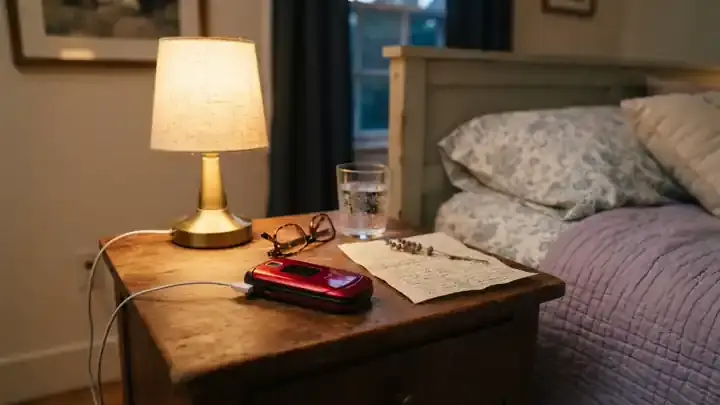
I plugged it in on the nightstand, and that's where it has lived every night since.
Step three: opening the lid. The buttons light up and the screen shows a menu.
It's a list, one item per line, in letters I can read without my glasses.
You move up and down the list with an arrow key and press OK. There's nothing to swipe and nothing slides away from you.
Step four: the contacts. I added eleven names that first evening, typing each one on the keypad the way we did on the old flip phones.
Doug, Lainey, Verna, Arturo, the pharmacy, the church office and a few more.
It took me an hour, with a few false starts. But at the end of that hour, the names were there in big letters, alphabetical, one under another.
Step five: the first call. I held the phone, said "Dial Lainey," and listened to it ring in Colorado.
She picked up on the second ring and said, "Gran? Is this you?
Whose number is this?" It was my number, the same one she'd had all along, on a phone I could finally find.
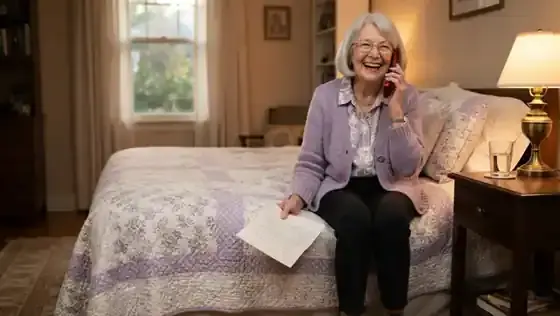
We talked for twenty-six minutes. When we said goodbye, I closed the lid, and it snapped, and I laughed out loud in an empty bedroom.
Seven Things This Phone Does Not Do
A purchase order isn't finished until you write down what you're not getting. Here's mine, because I think it matters more than the list of features.
One: it's not a smartphone. It runs a basic version of Android in the background, but you won't be scrolling social media or downloading games on it.
If you want to video-call your grandchildren on a big screen, this is the wrong tool. Keep the tablet in the drawer for that, or ask for help with it.
Two: it doesn't come with a plan built in. The $59.99 buys the phone.
The service is a separate monthly bill, and the phone won't work with other carriers.
Three: the emergency button isn't connected on the Basic plan. I've already said it once, and I'll say it again in the price section.
Four: it doesn't remember for you. It holds the names you put in it, in big letters.
Saying "Dial Lainey" means I don't have to recall ten digits, but I still have to remember to call.
Five: it's not a medical device. Nothing on this page, or on the seller's page for this phone, claims it does anything for your health.
It's a telephone.
Six: the screen is still small. 3.2 inches is large for a flip phone, but long text messages still mean scrolling with the arrow key.
Seven: it's not a gift that sets itself up.
Somebody has to activate it and load the contacts.
In my case that was me, Verna on speaker and one patient woman on a customer service line.
That's all seven. If any of them is a dealbreaker for you, stop reading here, and I mean that kindly.
If none of them is, the rest of this column is about what happened over the next twelve weeks, and about what the drawer looks like now.
What the Seller Shows, and What It Doesn't
At the school office, I never ordered anything for the classrooms without asking two other teachers what they thought. So I went looking for reviews.
Here is the plain fact: the Flip3's page, when I read it in October 2026, did not show customer reviews for this phone.
I looked twice, on the tablet and on the library computer.
There are reviews online for the older model, the Flip2, but the seller lists that one as discontinued. I'm not going to borrow another phone's reviews and pretend they're about this one.
So this column has no customer quotes in it, and the sidebar shows the phone and its prices instead of star ratings.
That's the honest version, even if it's the less exciting one.
What I can offer instead is the one review I'm qualified to write, which is my own. And I can offer something every school secretary knows how to run: a side-by-side test.
Five Phones on the Bedspread, One Afternoon
On a rainy Saturday in late May, I took all four phones out of the drawer and laid them on my bed beside the red one.
I charged the ones that would still charge.
Then I gave each one the same three jobs, the way I'd test a new copier at school. Call Lainey, find a text from Verna, turn the ringer up.
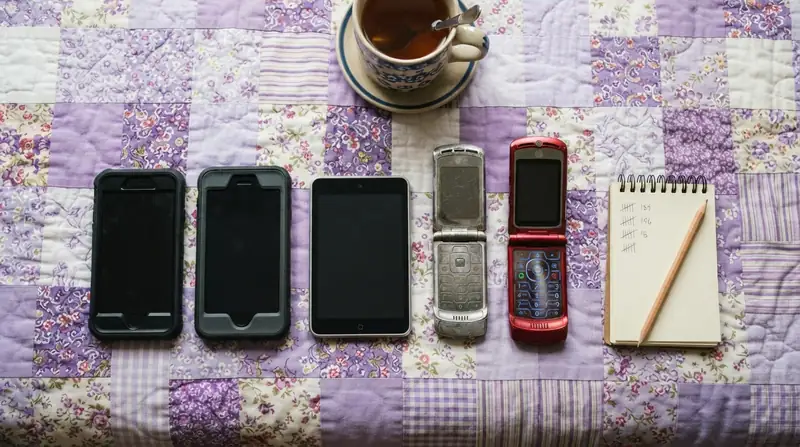
The hand-me-down smartphone: I found Lainey after two wrong taps, found Verna's text in the wrong app first, and turned the ringer down instead of up.
The tablet: it asked for an update before anything else. I gave up after eleven minutes, which I wrote down with some satisfaction.
The easy-mode smartphone: I'd already returned it, so it got an honorary zero. I'm counting it anyway, because it cost me two phone calls and a post office trip.
The old silver flip: it wouldn't hold a charge for more than a minute. It got to ring once, very loudly, and then it went back to sleep for good.
The red Flip3: "Dial Lainey" worked the first time. Verna's text was under Messages, at the top of the list.
The volume buttons are on the side, and I turned the ringer up without looking.
I know a test like that proves nothing scientific. It's one woman, one afternoon, one bedspread and a pencil.
But I've never been a scientist. I've been the woman who decides which copier the school keeps.
And the red one kept the job.
Testing, this is Gran on the red phone. Typed it myself.
7:05GRAN, you texted! I'm framing this.
7:06Do not frame it; write me a letter instead. Still writing?
7:11Always, letter's in the mail Monday. Call you Sunday at 4?
7:12I typed that first text on the keypad the old way, pressing the 8 key once for "t" and the 3 key twice for "e."
It took me five minutes and I was proud of every one of them.
The letters didn't stop. That's the part I didn't expect.
Lainey still writes every ten days or so; the difference is that now I can call her the day the letter arrives.
Why the First Bill Looks Bigger Than the Rest
Here's something I wish someone had shown me with a picture before I ordered. The first month costs much more than the months after it, and that's normal.
In the first month you pay for the phone, the activation and your first month of service. After that, it's only the plan, the admin fee and the taxes.
So in my case, the first month came to about $113 before taxes and shipping. Every month after that, the plan and the admin fee come to $18.22 before taxes.
If you add the $5 for unlimited talk and text, it's $23.22 a month before taxes. If you skip paperless billing, add another $5.
I kept paper billing for the first two months, because I wanted to see the bill on paper and check it with my highlighter.
Then I switched to paperless and saved the $5.
The Bill and the Phone Have Different Jobs
In this dramatized kitchen-table scene, Verna brought her reading glasses and I brought the highlighter.
We put the bill beside the phone, rather than using the phone price as the heading for the whole purchase.
Then we read it by type of charge. The phone and activation belonged in one group; the plan and recurring fee belonged in another, with the variable charges kept visible beside them.
A charge that happens once and a charge that happens monthly answer different questions.
I wanted to know both what I needed to pay at the start and what I could expect to budget afterward.
Verna asked which billing choice I'd made. I pointed to the paper bill, because a paperless price wasn't my price until I actually chose paperless billing.
That seems obvious with a highlighter in your hand. It's less obvious when you remember the large number from an advertisement and forget the condition printed next to it.
I also wrote down what I wanted from the plan before thinking about changing it. Calling Lainey and reading Verna's texts were one set of jobs;
the Help button's Urgent Response service was a separate question.
Owning the button doesn't tell you which service you've bought. The plan chart and the company's confirmation have to answer that, not the color of the phone on the table.
If a line on my bill puzzled me, I'd ask what it covered and whether it would appear again.
I'd write the answer beside the line instead of nodding and hoping I'd remember the explanation later.
For someone helping a parent, that's a useful place to sit together.
Let the person using the phone say what they want to do, then read the matching plan and billing choices aloud.
The point isn't to win an argument about which plan is cheapest.
It's to leave the table knowing what was chosen, which charges repeat and which questions still need a call to the company.
Verna capped my highlighter before it marked the tablecloth. We had finished reading the bill, which was enough work for one cup of coffee.
Ten Letters That Came to the Nightstand
In June I mentioned the red phone in two lines of the church newsletter.
I got more mail than I've had since my retirement party, so I've answered the ten questions most of the letters asked.
The letters below are illustrative composites, retold from reader notes with names shortened. The answers are mine, checked against the seller's pages.
Short answers to the questions Verna gets after choir
How much does it really cost?
The phone is $59.99 (regular $79.99) and activation is $35 once. The Basic plan is $14.99 a month with paperless billing ($19.99 without), plus a $3.23 monthly administrative fee and variable surcharges and taxes.
What does the Basic plan include?
300 minutes and 300 text messages a month, and the Ask Lively 24/7 operators. Unlimited talk and text is $5 more a month on any plan.
Does the Help button work on the Basic plan?
Not for emergencies: the plan chart says Urgent Response requires the Preferred ($34.99) or Premium ($44.99) plan. If that button is your reason for buying, choose one of those and confirm it on the phone with the company.
Can I keep my old phone number?
Usually, yes. The seller says you can transfer your number from another carrier, subject to that carrier's approval and your number's eligibility.
Can I use it with my current carrier?
No. The listing says the phone comes with a Lively SIM card already inside and "cannot be used with other carriers."
Is there a contract?
The seller says no long-term contract, no cancellation fees, and you can switch plans anytime. The federal label on the page lists the early termination fee as "None."
Will it work with my hearing aid?
The listing says it's hearing-aid compatible under HAC 2019 and prints the conversational gain: 13.00 decibels without a hearing aid and 6.91 with one. Ask your audiologist what those numbers mean for your own aids.
How long does the battery last?
The seller says up to 12 hours of talk time, and adds that actual battery life varies and decreases over time. I charge mine every night by the lamp.
Can it text and take pictures?
Yes, it texts from the keypad and has a 5-megapixel camera with a flash. It isn't a smartphone, so don't expect apps or social media.
What if it isn't for me?
30 days from delivery, with a return authorization number from 1-800-733-6632, in like-new condition. Stay within 30 minutes, 50 texts and 50 MB for the full refund, and cancel the service separately.
Twelve Weeks on the Nightstand, Good Days and Clumsy Ones
I kept a log, because of course I did. A school secretary keeps a log of the copier jams; I wasn't going to skip one for my own telephone.
I wrote it in a small notebook I keep beside the lamp, one line a week. Here it is, trimmed only where I complained about the weather.
Nora's nightstand log, June to August
- Week 1Activated by phone, old number kept. Eleven contacts typed in one evening. Called Lainey with "Dial Lainey" and talked 26 minutes. Closed the lid just to hear the snap.
- Week 2Clumsy week. Locked the side volume by accident and couldn't hear the ringer for two days. Found the answer in the printed guide, page by page, with my reading glasses.
- Week 3Called Doug on a Tuesday for no reason at all. He asked if something was wrong. Nothing was wrong; I just could.
- Week 4Left the phone in the car all night. It was fine; I was mortified. Started charging it in the same spot by the lamp every single night.
- Week 6First full week with no help from anybody. Answered every call on the first try. Texted Verna "number please" and she sent back a row of happy faces.
- Week 8First full bill read with the highlighter. Plan, admin fee and taxes all where the page said they'd be. Switched to paperless billing to save the $5.
- Week 10Phone rang at the Kroger checkout and I answered before the second ring. The young man behind me said, "Nice phone." I said, "Thank you, it's red."
- Week 12Took everything out of the drawer except the letters.
I want to slow down on week two, because it's the week most people would put the phone in the drawer with the others.
Two days of not hearing it ring is a long time when you've been waiting for a call.
What I'd done was press the side buttons while the phone was in my pocket.
The guide explained how to lock the volume buttons so that can't happen, and Lively's page has the same steps.
The point isn't that the phone was perfect in week two. The point is that the answer was printed in a booklet I could hold, and the steps were the same the next day.
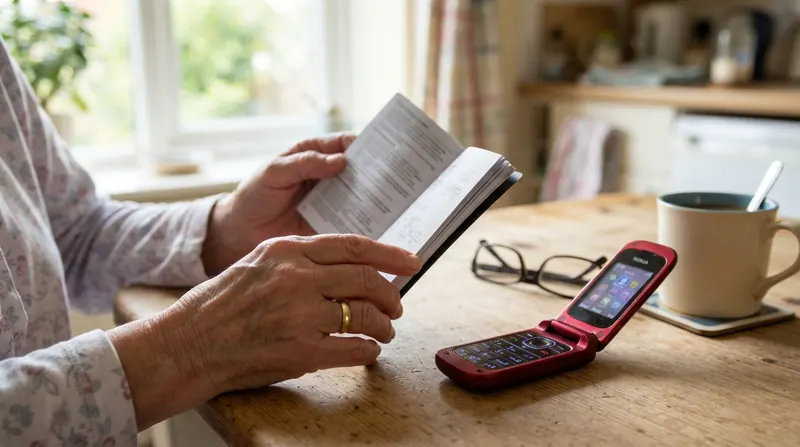
Week three is the line I'd circle if I were grading this. "Called Doug on a Tuesday for no reason at all."
For six years, I only called my son when something was wrong, because calling took effort. In week three, calling took one sentence and one snap of a lid.
That's not a scientific measurement.
It's a pencil line written by a woman who used to wait until Sunday to call anyone, because Sunday was when she had the energy to fight the phone.
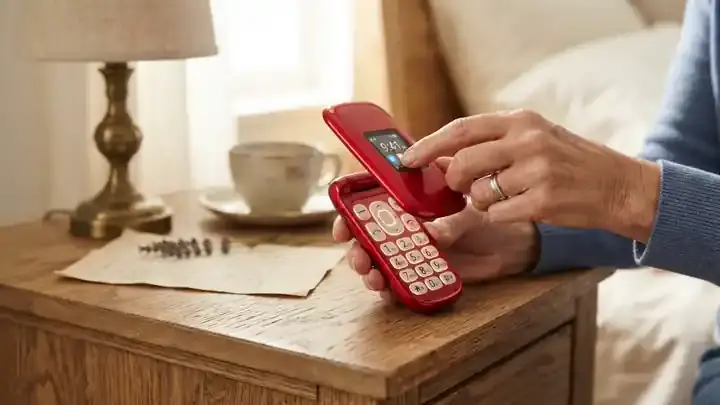
Week ten made me laugh. For years my phone rang in public places and I'd dig through my purse like a raccoon in a trash can while it rang out.
The red one rings loud, and it's easy to find by feel because of the shape and the grip.
I answered at the Kroger checkout before the second ring, and I felt about forty years younger.
And week twelve is the one I'm proudest of. I emptied the drawer.
The hand-me-down went back to Doug, who gave it to his teenage son.
The tablet went to the church nursery for the toddlers' cartoon hour, with a note about the password I still don't know.
The old silver flip phone went to the electronics recycling bin at the library. I kissed it goodbye first, and Theo the librarian pretended not to notice.
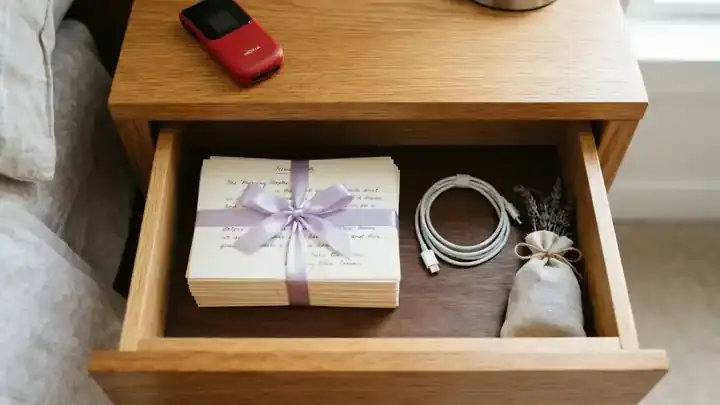
The drawer now holds the letters, tied with the lavender ribbon, and a spare charging cable. The red phone sits on top of the nightstand, by the lamp, where it belongs.
What Changed, and What Didn't
I promised I'd be honest about my own head, so here's the follow-up. The small slips didn't go anywhere.
The keys still wander. I still forget the grocery list on the counter, and I still sometimes stand at the window with a word on the tip of my tongue.
What changed is the phone part. When I can't recall a number, I don't need it, because "Dial Arturo" does the remembering of the digits for me.
And yes, I said "Dial Arturo." His name is the first one in my contacts, alphabetically, because I put him there on purpose.
I see it every time I open the lid. A-R-T-U-R-O, in big letters, every single day.
I haven't waved "Morning, neighbor!" at him since June.
I don't claim the phone did that.
I claim that seeing a name in large print every morning is a nice way to keep it close, the same way Lainey's letters keep her handwriting close.
Nora, is that you texting? Lainey told my wife you got a red phone.
9:02It's me. Your name is first on my list now, A for Arturo.
9:09I'm honored. Tamales on Saturday, mowing first.
9:10I'll have coffee on the porch. Snap, that's the lid closing.
9:14
Reader Notes on the Summer Column
A longer version of this column ran in the church newsletter in August. The notes that came back were better than the column, which is usually how it goes.
The comments below are illustrative, retold from reader notes with names shortened. Replies sit indented under the comment they answer, and they're here because they ask what you're probably asking.
Verna and I, Recorded for the Church Newsletter
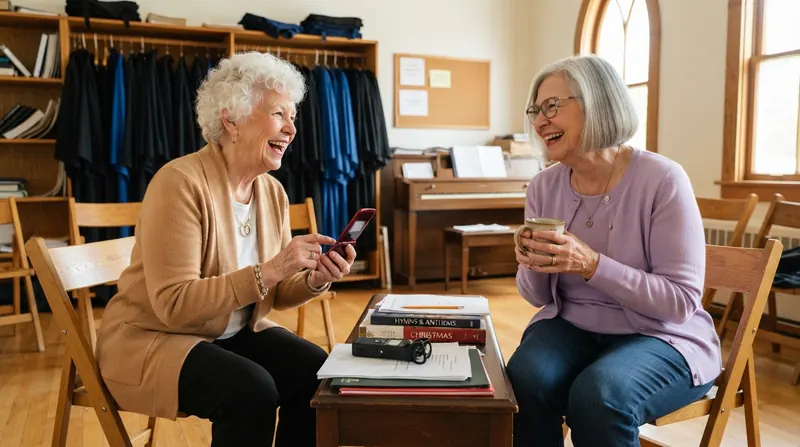
In September, the newsletter editor asked whether Verna and I would let her record a conversation for the "Neighbors" page. Verna said yes before I could say no.
We sat in the choir room after practice with two cups of coffee and the editor's little recorder on the piano bench.
Here's the transcript, trimmed only where the custodian came in to stack chairs.
Neighbors · The Choir Room Tapes, Episode 2
An Old Operator, a School Secretary and One Red Phone
Nora
host
Verna, the newsletter wants to know why a retired operator showed her phone to a woman she'd sung next to for nineteen years, and not a day sooner.
 Verna
guest
Because you never told me you had a drawer, Nora; you hid four phones from the alto section. I only found out because you sighed when mine rang.
Nora
host
I did sigh, at the snap of the lid. I hadn't heard a phone close like that since 2010.
Verna
guest
That snap is the whole design: you open it, you talk, you shut it, it's done. The glass phones never tell you a call is over; they just go dark and leave you guessing.
Nora
host
You told me the phone was cheap and the plan is the part you read. People ask me about that line more than anything else in the column.
Verna
guest
Because it's true of every phone ever sold; my first bill at Ohio Bell, I made the supervisor read it to me twice. This one has five numbers, the phone, the activation, the plan, the fee and the taxes, and you know all five before you say yes.
Nora
host
And the red button. You were the one who told me to check which plan it works on.
Verna
guest
I'm on the middle plan because I live alone out past the reservoir and my son worries, and you're four doors from Arturo with a landline: different women, different plans. Read the chart, then call them and make them say it back.
Nora
host
Last question. What would you tell somebody with a drawer like mine?
Verna
guest
Stop learning phones that were built for your grandson, and pick the one you'll actually open. Then use it to call somebody on a Tuesday for no reason at all.
Verna listened to the recording afterward and asked for one correction. She wanted it on the record that she has never once sighed in the alto section, which the sopranos dispute.
I've gone back to her last line more than any other. "Pick the one you'll actually open."
It's nearly word for word what Lainey wrote in her letter, and the two of them have never met.
Red or black · read the plan chart and fees on the seller's page before ordering
The Return Policy, Read Like a Contract
Now the part most columns skip, and the part I'd have read first at the school office: what happens if it isn't for you.
I want to be plain here, because phone companies are where return policies get complicated.
This is a 30-day return policy with conditions, and I'm going to describe the conditions.
The window: 30 days after you receive the phone. You call customer service at 1-800-733-6632 and ask for a return authorization number before you send anything back.
Returns sent without that number won't be accepted, according to the policy. Write the number on a sticky note and put it on the box.
The condition: "like-new," in the original box, with all the parts. Shipping charges aren't refunded, and you pay for the return shipping yourself.
What gets refunded: if you return the phone and cancel the service within 30 days, Lively refunds the cost of the phone, the first month's service charge and the taxes.
The policy also mentions a restocking fee without giving an amount, so ask about it when you call.
The activation fee: refunded only if you cancel within the first 7 days, with a few exceptions. That's a much shorter window than the 30 days, so mark it on your calendar.
The usage limits: this is the part I read three times. The refund assumes you used up to 30 minutes of talk, 50 text messages and 50 MB of data before cancelling.
Above those amounts, the policy says you're charged the lesser of your monthly plan price or a per-unit rate, 35 cents a minute or 10 cents a text. In plain words:
if you talk a lot in the first month and then return it, expect to pay for that month.
And the line that surprised me most: returning the phone does not cancel the service. You have to call and cancel the service separately, or the monthly charges keep coming.
Here is what I'd actually do, as a woman who spent thirty-one years telling teachers to read the warranty card.
Use the phone gently for the first week, while the activation fee is still refundable.
Make your test calls, load your contacts, call your granddaughter once and keep it short. If you know by day seven it isn't for you, that's the cheapest time to decide.
The company is Lively from Best Buy Health. It prints a mailing address in Reno, Nevada: 9390 Gateway Drive, Suite 100.
Customer service is 1-800-733-6632, weekdays from 7 a.m. to 10 p.m. Eastern and weekends from 9 to 7.
The sales line, for questions before you buy, is 1-800-918-8543.
A mailing address, two phone numbers that people answer, and a return policy with real numbers in it.
My checklist for any vendor at the school was three lines long, and this one ticked all three.
Shipping, for the record: economy shipping is $8 and takes 3 to 8 business days, waived on orders over $25. Expedited is $20 for 1 to 3 business days.
Who This Phone Is For, and Who Should Skip It
I wouldn't close a purchase order without a recommendation, so here's mine. Fair notice: half of it tells some of you not to buy.
It probably makes sense to look at it if:
- You have a drawer of phones and none of them stays where you left it
- You want buttons you can feel, a lid that snaps shut and a screen that doesn't slide
- You mostly call and text, and 300 minutes a month sounds like plenty, or $5 more for unlimited sounds fair
- You'd rather say "Dial" and a name than remember ten digits
- You'll read a plan chart line by line and call the company with questions
It probably isn't for you if:
- You want video calls, photos of the grandchildren on a big screen, or apps; this is a telephone, not a tablet
- You want emergency help from the Help button but only want to pay for the Basic plan; the chart says that service isn't on Basic
- You want to keep your current carrier; this phone works only with Lively
- You're hoping a phone will help you remember things; it holds names in big letters and nothing more
- You don't want any monthly bill at all
That fourth line on the second list matters most to me.
This is a telephone, not a plan for your head; the plan for your head is whatever you and your own clinician talk about.
What the Phone Costs Against What It Replaced
Now the money, because Verna made me promise I'd put it in black and white. The phone is $59.99, marked down from $79.99.
Over a full first year on the Basic plan, before taxes and surcharges, that comes to about $313.63. That's the phone, the activation and twelve months of plan and admin fee.
I'm not going to compare that to anybody else's phone bill, because every bill in America is different. I'll compare it to the drawer.
The drawer held four phones I didn't use, one return I'm still not sure was refunded in full, and six years of calling my son only on Sundays.
The red phone costs $18.22 a month before taxes, and I use it every day.
If unlimited talk and text matters to you, it's $5 more.
If the Help button's emergency service matters to you, look at the Preferred plan at $34.99, and add the admin fee and taxes to that too.
Where the Red Phone Stands, Line by Line
Here's the summary I'd staple to the front of the purchase order. If you only remember one part of this column, make it this one.
✓ Buttons you can feel and a lid that snaps shut: big, backlit, tactile keys, a no-slip grip and a 3.2-inch screen with large text, all printed on the seller's page.
✓ Calling without remembering digits: say "Dial" and the contact's name, or use speed dial, with a loud speaker and hearing-aid compatibility listed.
✓ A plan with its prices printed out: $14.99 Basic with paperless billing, $3.23 admin fee, $35 activation, no long-term contract and no cancellation fee.
✓ People who answer the phone: a sales line, a customer service line with evening and weekend hours, and a mailing address in Reno, Nevada.
✗ The Help button's emergency service isn't on the Basic plan. It needs Preferred at $34.99 or Premium at $44.99, before fees and taxes.
✗ No customer reviews for this model on the seller's page when I read it, and the older model's reviews don't count.
✗ Works with one carrier only. The phone comes with a Lively SIM and can't be moved to another company's service.
✗ The return policy has usage limits. 30 minutes, 50 texts and 50 MB in the first month; the activation fee comes back only within 7 days;
and you must cancel the service separately.
If You're Standing Over Your Own Drawer
I can't tell you what to do.
I can tell you what I'd do if I were reading this column instead of writing it, back in the spring, standing at a pharmacy counter without my own number.
First, before you buy anything at all: open your drawer and count the phones. Write down what each one was supposed to do and why it didn't.
Second: ask yourself Lainey's question. Which kind of phone would you actually open?
A lid, a list and buttons you can feel, or something else entirely?
Third: decide what the phone is for. If it's for calling and texting family, the Basic plan may be enough.
If it's for help in an emergency, read the Preferred plan line by line.
And fourth, if the answer is a flip phone: read the seller's page I've been describing for ten thousand words.
Then call the sales line at 1-800-918-8543 and ask them to read the five prices back to you.
I won't pretend a link at the bottom of a nightstand column is anything but a door to the seller's shop. Flip Phone Letters doesn't sell phones; we write letters about them.
But if you walk through that door, you'll know exactly what's on the other side:
a red or black flip phone, five prices, a Help button that needs the middle plan, and a company that answers its phone.
Flip phone with big buttons · plan chosen at activation · check the plan chart first
One more thing, and then I'll let you get to your own evening. The red phone is on my nightstand right now, beside the lamp and the latest letter from Colorado.
Last night's line in the log reads: "Oct 25. Called Lainey, 41 min.
Called Doug, Tuesday, no reason.
Texted Arturo about tamales. Letter from L. on the nightstand, answer tomorrow."
No reason. Two words, in pencil, written by a woman who once spent nineteen minutes finding a single text message.
P.S. Lainey's first letter from Colorado, the one with the pressed aspen leaf, is still on top of the stack in the drawer; if you have a granddaughter who writes, write back, and then call her the same day.
P.P.S. Remember what Verna said in the choir room: pick the phone you'll actually open, know all five prices, and make a person say them back to you before you pay.
The full guide to this phone's features and plans, with a note on reading the advertising around phones sold to older adults, is linked at the foot of this page.
First, the people: Nora Bellamy is a pen name. Verna, Lainey, Doug, Arturo and the Wednesday choir are composites, the way kitchen-table columns have always been written.
Everything about the phone itself comes from the seller's own pages, read in October 2026. That covers its buttons, its screen, its price, its plans, its fees and its return terms.